Return to Sacred Sea home page
Version française clickez ICI
Sacred Sea - Artist interview
Liene Jurgelāne
Bridging the realms of art, anthropology, and earth-based traditions, Liene Jurgelāne crafts a practice rooted in the sacredness of the everyday and the more-than-human world. Growing up at the edge of a Latvian forest, her lifelong dialogue with plants and living systems now manifests as participatory performances, transformative group spaces, and her work organizing the ROOTED Festival. Based out of the vibrant creative platform Institut for (X) in Aarhus, Denmark, she curates cultural spaces across Europe. Whether serving as an artist, facilitator, or cultural instigator, Liene invites us to reimagine what it means to care, connect, and cultivate belonging in times of transition.
How would you describe yourself and your practice today, across art, facilitation, plantwork, and community building?
Liene: I often say that my practice is a little bit like a wild garden that I am tending to. It consists of these different areas of my work that each have their cycles. This year, for instance, the art corner of the garden was thriving and so I was tending to that more. Other times its other corners of my practice that give more fruits. But what connects them all is that they all move the cycles of fallow, seeding, sprouting, harvesting, each in their own rhythm.
You grew up in Latvia, on the edge of a forest that became a place of refuge and interspecies friendship. What did that landscape teach you as a child?
Liene: Yes, our street was literally the last one before the forest and so I spent just as much time in the forest as I did in our garden and home. It was a space of wonder, play, adventure. I would talk to birds, and follow the river curves, and build branch huts, and talk with birds and trees and pretend to be Ronja (from “Ronja, the robber’s daughter”, which was my favourite book as a child). I think this taught me in a very direct way that I am part of a world that is bigger than humans. That there are so many other beings with whom we are in relationship. It taught me timelessness, and play and feeling safe among trees.
You mention learning about plants from your mother, your grandmother, and the plants themselves. What kinds of knowledge were passed down to you?
Liene: As a child I had to take part in all the labour that went into preparing food and medicines and teas for the year. For the bigger part of my childhood we grew most of our food and foraged the rest. Which meant both working in the garden - sowing, planting, weeding, harvesting, and going on foraging walks with my grandma and/or mom to harvest plants and mushrooms. So I learned the names and uses of the plants, mushrooms, trees, and how they are grown or where they can be found when early on through the work with them.
You speak about plants not simply as resources, but as kin and allies. What changes when we begin to relate to plants in this way?
Liene: This is something that shifted for me about five years ago - to start to see that plants have their own stories, agency, intelligence, gifts that are not all about the humans. Growing up the way I did taugth me to be in a close relationship with plants, but looking at it with today’s eyes I see it to also be a very transactional one. While I was taught also reverence and respect for plants, and I remember my grandma always asking for blessings to the forest mother before entering the forest,, it was still very much rooted in the thought that plants/ forest/ animals are there to serve our needs. Since I started to see plants as kin, friends, allies, the relationship is slowly shifting from using plants to collaborating with them - whether its in food, art, health or spiritual practice. This then also came with a set of questions that I am regularly sitting with - how do I credit plants that I collaborate with, for instance, in art? How do I want to show up in this relationship? How can I return the gifts? What can I offer the plants? What would it mean for me to become an equally good ally to the plants as they have been to the humans for millions of years?

Is there a particular plant that has become a teacher or companion for you?
Liene: By now there are quite a few that I consider my teachers and friends, but the closest continuous companion is Yarrow - she was the one that opened my eyes to the depth of the plant universe, to their intelligence and to the beauty of collaborating with plants. Five years ago I had an encounter with Yarrow, that I now refer to as an act of con-spiracy (borrowing this term from Natasha Myers) from her. After drinking some yarrow tea I had strong visions that both brought back a lot of plant memories and teaching from childhood but also a clear, unshakeable clarity about the wisdom and power of plants and that I am being called into a new path of my practice - one shaped by deeper relationships with plants. It is still one of the strongest experiences of magic and mystery in my life and I have been tending to the relationship with Yarrow ever since.
What have plants taught you about care, reciprocity, or community?
Liene: Plants are continuously teaching me about presence, generosity, and the importance of building webs of reciprocal relationships. Plants know how to care for themselves, but they also care for the collective, something that is becoming more and more forgotten amongst many humans it seems. They constantly build relationships with other beings to make the ecosystem livable not just for themselves but for others, and this is something I am reflecting on often in my own practice - what relationships am I creating, how can my work support not just me but also others, how are community-care & self-care informing each other in my life?
Your artistic research explores plant-human relationships and communication. What are you really listening for when you listen to a plant?
Liene: I am listening for shifts in my own body, as thats the domain where I most experience that, which I refer to as plant communication. It can be subtle shifts in how my body feels, emotions that raise up, a melody or a rhythm that starts from the body, an impulse to make a movement that was not there before etc. We are constantly in a relationship with plants, that is a given - simply by breathing and eating or digesting, we are in a physical relationship with plants. Hence, I think its so intuitive to start from the body, thats where the connection can be most felt - in the sensuous.
Do you think artistic practice can help us access forms of knowledge that rational language cannot?
Liene: I definitely think that artistic practice can widen our access to knowledge, widen our language, our relations. It enables access to our senses, emotions, intuition, rhyghtm, songs, relationships as a felt experience, instead of just something that we write about or categorize or understand with our minds. Also, knowledge systems rooted in what you call here rational language, exclude many knowledhes that are knowledges in their own right. As children, talking with trees, telling them stories and listening back feels quite normal. Then many of us are taught to distrust that kind of knowing because it cannot be measured or something. But it is real, and we need sensuous knowledge just as much as rational knowledge. Art is a beautiful container in which the sensuous is given permission to be engaged. I have heard this many times in reflections from audiences - that the artistic experience gives them permission to do "weird" things, which turn out not to be weird at all.
One of the things that feels compelling in your work is your description of your practice as part of a “broader work of repair”—repairing relationships between ourselves, each other, and the Earth. What do you think needs repairing most urgently in our relationship with the living world?
Liene: Lately I think a lot about our capacity to feel loss and to feel it together, as something that needs repair. Our sense of time, the ability to know time as cyclical not linear. The big gap of separation that modernity created - it needs repairing.

ABOUT “ROOTED” FESTIVAL
How was ROOTED born?
Liene: For some years I was contemplating doing a PhD research into practices of artists who work with plants. During this period I was reaching out to many and having conversations about their practices, and paths and so slowly there was this growing list of amazing people from different places that I was eager to connect somehow. And then at some point I was holding a workshop in plant communication in “Meadow festival” in Latvia and while sitting under a big willow tree and waiting for the participants to come back from their exercise, this idea came - that there should be a festival that connects plants, people, and art. That's how ROOTED was born. I am quite sure with the assistance of the willow and the grass around :)
You describe ROOTED as your “love partnership with plants.” What does that relationship look like in practice?
Liene: Ever since I met the writings of bell hooks, my understanding of love has been very much framed by her definitions of it - love as combination of trust, commitment, care, respect, knowledge, responsibility, extension of one’s self for the purpose of nurturing both one’s own and another’s spiritual growth. Love as choice and practice of the above. So in the case of ROOTED it looks like, for instance, consulting with plants throughout the process of curating and producing the festival, and trusting that guidance; inviting contributions that altogether represent the diversity and complexity of our entanglement with plants; visibilizing the plants involved in the festival in different ways etc.
ROOTED brings together artists, practitioners, plants, rituals, performances, workshops and sensory experiences. What becomes possible when these worlds meet?
Liene: A buzzing, deep, vibrant web of connections. Space for experimentation, exchange and inspiration. A wider understanding of artistic practice, one that steps out of the institutional, highly professionalised boxes art is often kept in and returns to its collective nature. A rich array of invitations to sense and experience the world, to root in ancestral stories and traditions while weaving new worlds together. And an art festival that is open to more kinds of people.
Why was it important for you to create a festival rather than simply an exhibition or a series of workshops?
Liene: I love the format of festivals as they create a moment of exception, where for a few days, something becomes possible that isn't possible outside its borders - in case of ROOTED its a different way of being together, a world in which we are already practicing being in the relationship with plants as if that was the daily truth, an intensity and even excess of experience that can shake, stir, open something in a strong, but gentle and slow way. There is also the aspect of people gathering in a particular moment and space and becoming some kind of temporary community for the duration of the festival. And while it is this exception, it is also a porous thing - everything that happens inside a festival inevitably has repercussions outside. By stepping out of the norm, even briefly, we see it more clearly - the habits, limits, complexity of it. And the days after the body still carries the pleasure of the exception back into ordinary life, and in that sense carrying the exception into the norm. That's why ROOTED had to be a festival. But at the same time thats not the only form ROOTED exists in. Next year we will take a fallow year to do smaller, more scattered happenings throughout the year, to then return with a festival again the year after. As all of these forms have their own medicines.
You describe ROOTED as both repair work and celebration. Why do you feel we need both right now?
Liene: In this I am inspired a lot by the Work That Reconnects. In this work gratitude, joy and celebration is the medicine that grounds us, roots us, sustains us. They remind us what we love and what we are part of. In a system built on extraction and endless wanting, delighting in and celebrating what is already here is in itself already a radical act. I am also inspired by the work of Rebecca Solnit, who writes about how cynicism and despair can pose as clear-sightedness, while really they are serving the status quo. If we believe nothing can change, we stop trying. A world that keeps us exhausted, doom-scrolling and disengaged is convenient for those in power. Repair work that comes only from duty or fear burns out and I have experienced that myself. So yes, we need to be real about the fractures - all the devastation we know to be true. And this is real work that asks us to be in touch with our grief, anger, fear. But we need sustenance for it - and the joy, pleasure, love for the world, energy from being together is where I see this sustenance coming from. That's what we try to make space for at ROOTED.
What have the plants taught you about curating?
Liene: To trust emergence, intuition, surprise, slowness and magic.
Institut for (X)
You are deeply involved with Institut for (X) in Aarhus, where you care for a food garden, medicinal herb patches and a herbal tea library. How does this physical place shape your practice?
Liene: The philosophies of this place and the vast and diverse community of makers, doers, creators that (X) gathers is a constant inspiration for my practice - I love the edgy energy, and the focus on rather trying and failing than just planning and never doing. I love that this creates a space in an urban setting that is not just for humans, but also for birds, plants, trees and more. It is a constant reminder that also urban spaces are more-than-human spaces and it's a potent field of practice on how to weave relationships with plants and other beings in these contexts. Often when thinking about nature connection these romanticized views of people being in pristine, vast, “untouched” landscapes come in mind, but the reality is that most people live in an urban setting, so for me its about creating spaces in that context also that invite to slow down, to notice where we are and who else is there, to build connections across differences and species. And X is a perfect playground for that, there are so many possibilities to try and test and grow things. Right now together with a group of closer collaborators we are developing a new community house in X, called the NEST - a place for Earth, body, and connection. A living lab for collective exploration of what ecological practice means in concrete terms in doing, organizing, relating, creating. It’s super exciting.
How can a garden, a tea library, or a shared meal become a space for political or social transformation?
Liene: I really think one of the core wounds of our global society is the idea of separation: between humans and nature, and between humans living different realities. Tending a garden, getting to know and working with local plants, slowing down and sitting together to share a meal are, for me, all acts of reconnection. In their essence they are counter-cultural to the dominant culture of extraction, speed, disconnection and colonisation, imposed on everyone by a few. I started the tea library at X, for instance, hoping people would get to know the plants growing around us and discover how wonderful they are as teas. I hope this sparks questions: how come we consume so many sacred plants, like coffee and cacao, extracted from elsewhere as part of the colonial and capitalist project, while we have forgotten the ones right at our feet? A cup of nettle or linden tea won't undo these centuries of extraction, but it can at least be a small step towards a more conscious and respectful relationship with the plants in our life - which for me is absolutely political.
What does radical resting mean to you, and why do you think rest belongs in ecological activism?
Liene: For me it means treating rest as an integral part of life and its cycles, not as a reward for exhaustion, accomplishment, productivity or whatever else we allow ourselves the moment of rest for. Radical resting then means resting for resting’s sake. And it is so hard for me personally to practice that. It's probably one of the most challenging things. The area of rest is where I see just how deeply I have internalized the productivity madness and the neglect of the body over the mind's activities. What helps me somehow is constantly reminding myself that everything around us has moments of fallow, wintering, darkness, inwardness, inactivity just as there are moments of high activity, abundant sharing and visibility. And that any kind of activism truly starts from our own lives - in the case of ecology - if I really embody the awareness that I am the Earth expressing itself in this body - how does treating it with kindness and care looks like?
Imagining other futures
You often create spaces where people can imagine more livable futures. Why is imagination so important in times of ecological and social crisis?
Liene: For me imagination is one of the key strategies of survival and thereupon thriving. Sadly, I think many of us have lost the ability to really imagine and dream, and it's not a personal failure. Colonialism and capitalism have policed our imagination - keeping us exhausted, distracted, overwhelmed — so that the imaginaries with power belong to those who benefit from things staying just as they are. So that change seems impossible and hope naive. But the reality is that many impossible things have happened many times before already because of how people chose to show up even without any certainty of the outcomes. And this is also why often in the spaces I create we work with memory as a wellspring of imagination. Imagination is not just a future domain - it also lives in looking back to what imaginaries have come true, what transitions have happened, what movements have started from seeds, and use that as a source to keep imagining even further “impossible things”.
What would a truly plant-centred society look like to you?
Liene: Here, I have been very inspired by Natasha Myers and her idea of the Planthroposcene. Instead of the Anthropocene, an age defined by human impact, she invites us to imagine an age in which we learn to live with plants, and from them. A plant-centred society would mean letting plants change how we sense, move and organise our lives. Myers talks about "conspiring" with plants, which literally means breathing together. I love this so much, because it's already true - every breath we take is shared with the plants, so it’s really just about remembering about it and landing in an awareness of it. For me, a plant-cetnered society would move more slowly, value being rooted in place and knowing the plants that grow around us. It would embody the awareness that all thriving is mutual and it would leave room for the wild and unruly, the parts of the world that don't fit neatly into grids, plans and profit.
And finally: what does it mean to be rooted without being still?
Liene: Aw, this is a question I am exploring constantly, being a person that moves a lot and living a migrant life, which often really makes me feel uprooted. Part of my mantra for this year is literally “stay rooted”. I am not sure I have a clear answer to this, but some of what has come up for me is thinking about roots not only as something in the ground, but also in the body. The songs and stories I remember from my childhood, the plants I recognise, the ways I've learned to notice the world. All of this moves with me wherever I go and makes me fel more rooted. Being rooted I think is also a practice of attention. Noticing who grows around us, how the land feels, who has lived here before me. And returning to breath constantly. Breathing is the most portable form of rootedness I know.
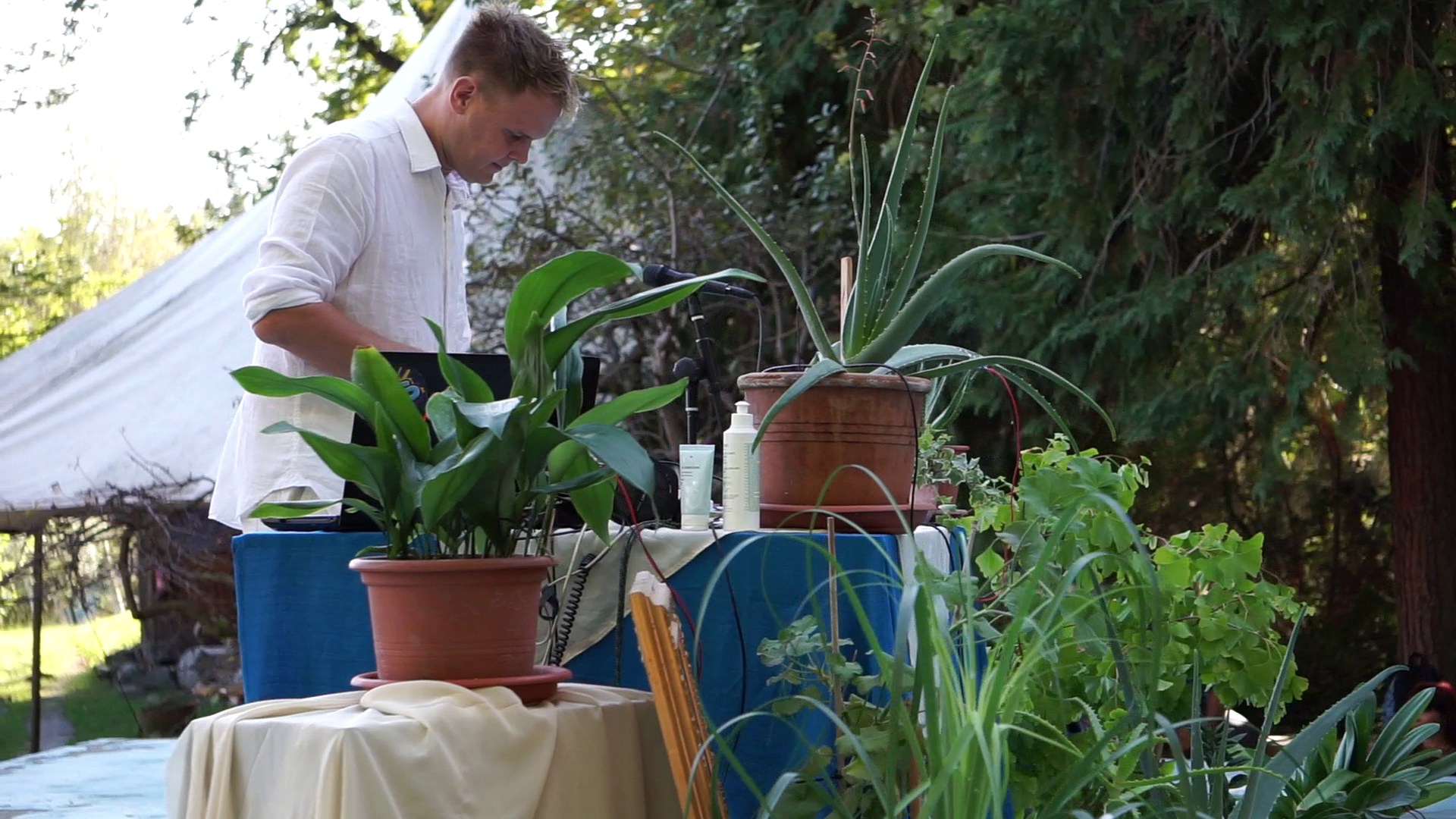
About the artist:
”Re-uniting Humanity and Ecosystem through Artistic Enlightenment”
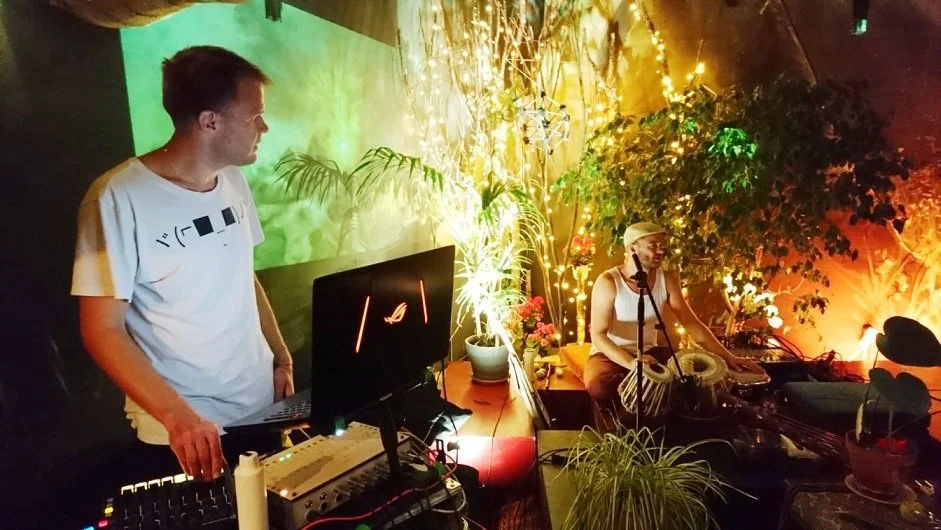
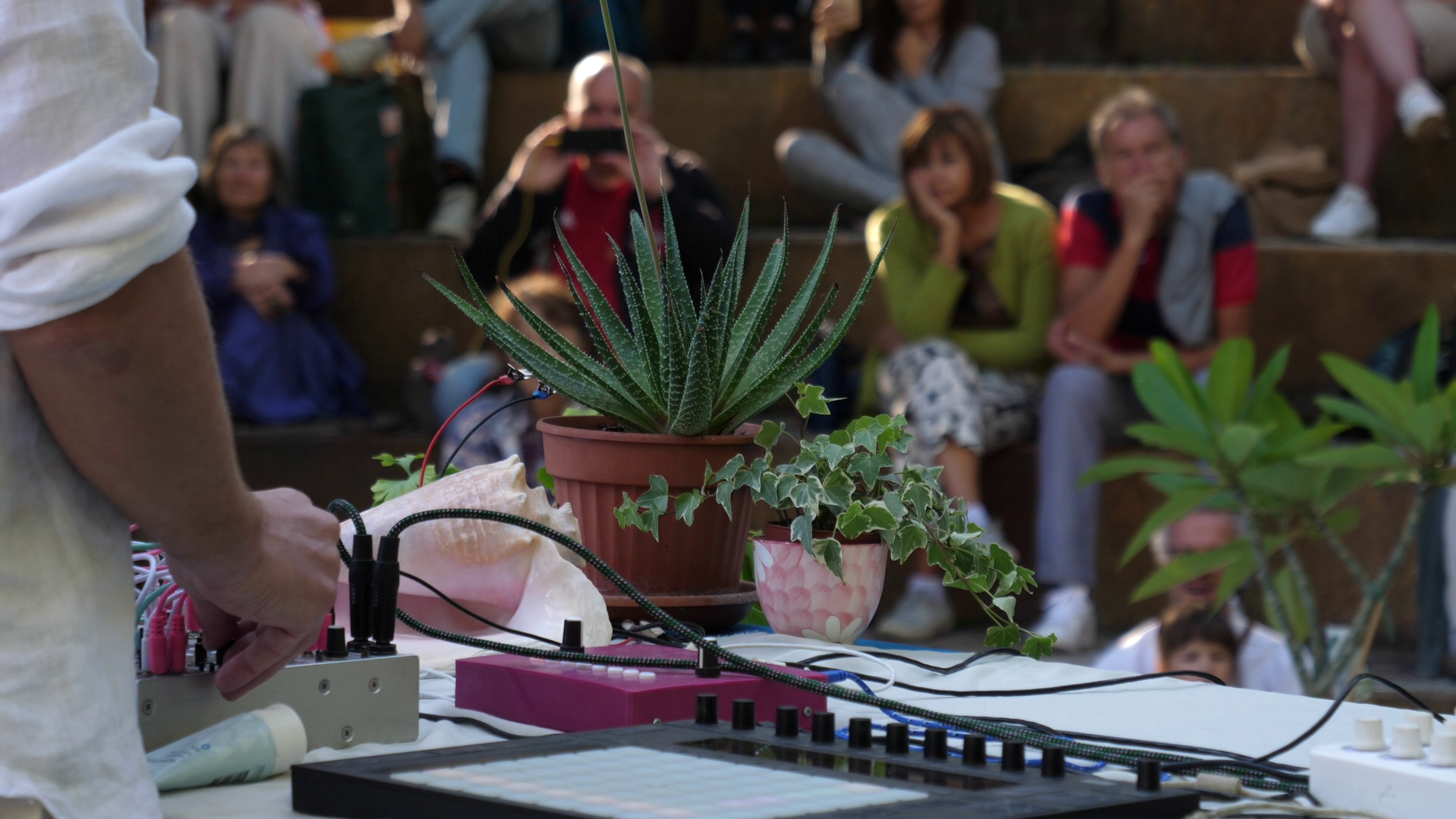
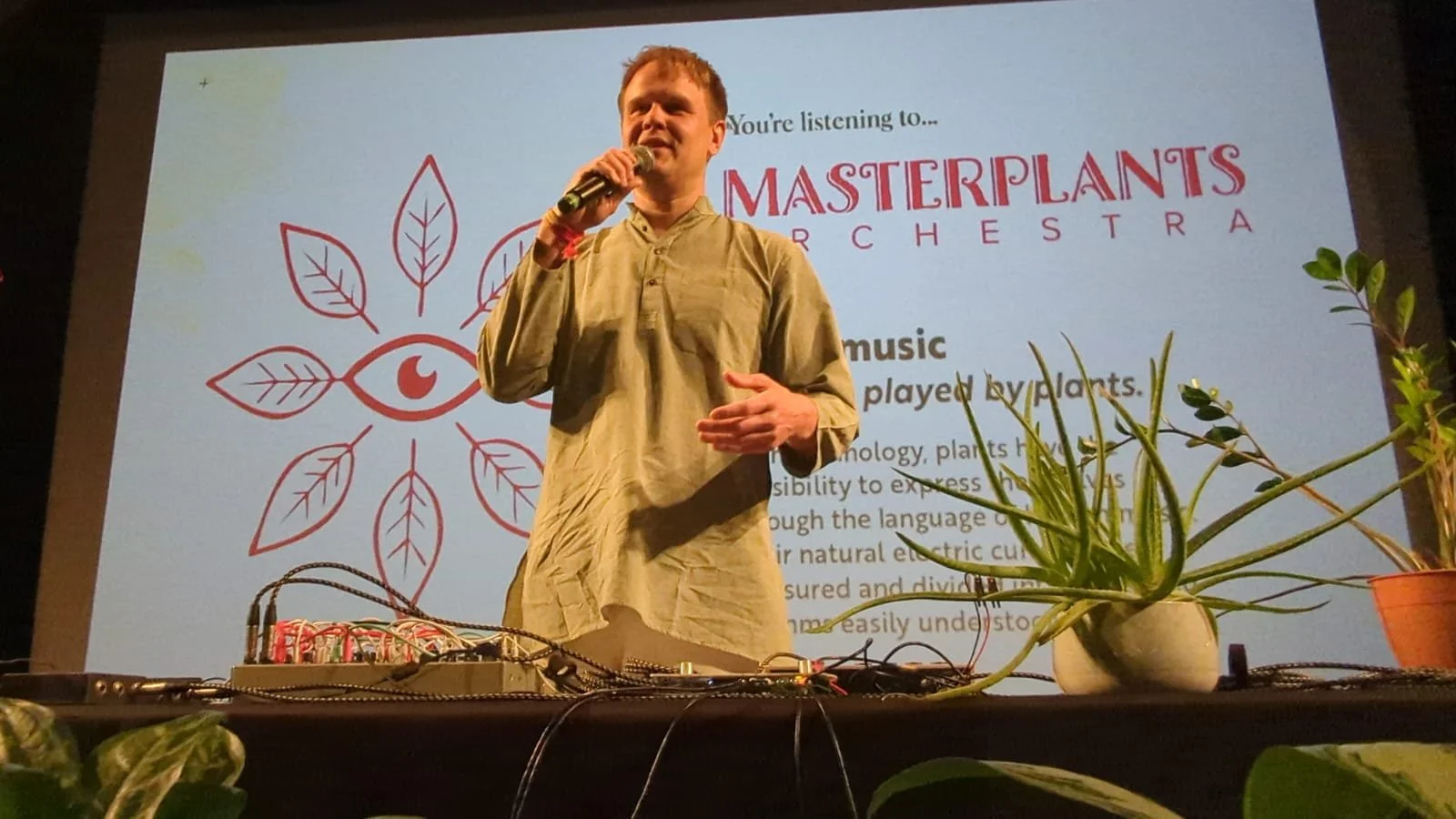
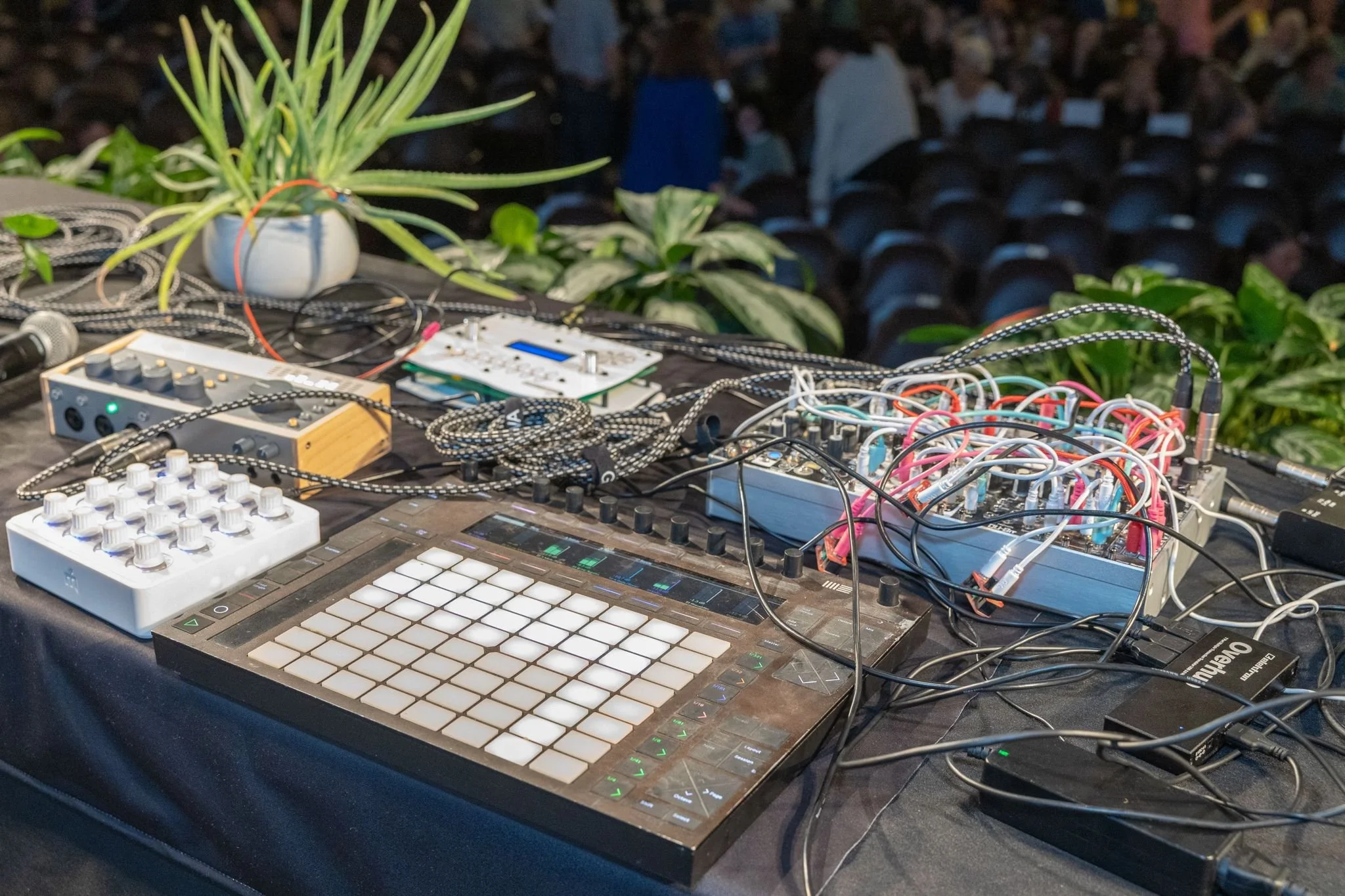
Masterplants Orchestra is a project lead by sound artist Tritone Crisantemo, designing musical devices able to translate the bio electric signal of plants into music through multiple channels. A member of the Damanhur community in northern Italy Tritone has traveled the world sharing his passion for nature and spirituality.